
A lively discussion on Amazon

I stayed up until 4AM on Feb. 7th to insure that mine was the first Amazon review of William J. Broad’s “The Science of Yoga.” My review is listed as “the most helpful critical review” and as of this writing 237 of 264 people found it helpful. It has also generated 47 comments by Amazon users.  It makes for some interesting reading.

yogijbrown: Is Your Yoga Safe?

Another great piece from my friend J. Brown’s blog.  He’s given me permission to re-publish on e-Sutra anything I think my readers will enjoy, and I’m sure this qualifies.

————————————-

From J. Brown:

Infrequent visitors to the yoga blogosphere may not be aware of the recent kerfuffle surrounding a NY Times article about how yoga will hurt you, but there also has been some mainstream media coverage on the safety of yoga.

While the article seems to have broken a few glass jaws in the broader yoga community, practitioners with a therapeutic orientation have been sounding alarms about questionable practice for years and getting nothing but flak in return. Those with the courage to take a stand and level public criticism of overly aggressive and guitar-hero-like approaches are usually written off as haters who are just jealous of the cool kids with their feet on their heads.

I’m not going to address the article directly. This has been done well enough already by voices more qualified than mine (I recommend watching Leslie Kaminoff’s three-part video response.) But I am interested in people questioning what they are doing and whether or not it is safe, even if it is a byproduct of a sensationalistic and irresponsible ploy to sell books.

Unfortunately, the subsequent conversation has largely been dominated by a reach for easy answers that avoid deeper issues. More often than not, injuries in yoga are being attributed to a lack of proper alignment or understanding of anatomy. It is said either that practitioners are not doing the poses in a technically correct way or that their teachers are not educated enough about anatomy to instruct students how to do the poses in a technically correct way.

When it comes to alignment, I find it curious to notice teachers who are are usually quite rigid in their instruction are now bending over backwards to explain how they respond to the needs of students. Specifically, I was reading an excerpt from a new book, written by a senior teacher in a classical tradition, who was considering the instruction to “straighten your leg.”

Without referring to any particular poses, the author asserts that the instruction is a “very coarse truth [that] new students need to hear” and that the way to accommodate different capabilities is to offer different “levels of truth” in the form of more detailed directives (i.e. lift the quadriceps, resist with the calf muscle, root the three corners of the feet, etc.) The suggestion is that different students need different details as they develop the fully realized truth behind “straighten your leg.”

The problem is that finding different ways of articulating the same arbitrary configuration is not an example of how to adapt to the needs of students and certainly will not make the practice any safer for the large majority of people who benefit from bending their knees. The concept of “technically correct” is open to interpretation and much of what is considered proper alignment in the classical forms is contraindicated for huge portions of the population. Thus, it is possible to have perfect alignment and still hurt yourself.

For those who are inclined to rely on science, I have written a full length article for Yoga Therapy Today magazine entitled: Does Studying Anatomy Make Yoga Safer? In the piece, I ask several prominent anatomy for yoga teachers to weigh in on the role of studying anatomy and science in making yoga safe. What I think most people might find surprising is that even the experts in the field do not agree that anatomy is the key to ensuring safety in yoga.

As Neil Pearson, clinical assistant professor at the University of British Columbia and the chair of the Pain Science Division of the Canadian Physiotherapy Association, put it: “In the end, it is not Western scientific knowledge of the human body that will make Yoga safer. Changing the students approach to the discipline of yoga and the practice of asana will create the greatest shift.”

Instead of looking to alignment and anatomy as a panacea for what ails the yoga profession, perhaps we would do better to foster a different mentality around the physical work of yoga practice that minimizes any potential risks and encourages smarter choices.

Most of the professionals I have spoken to agree that the key to safe yoga boils down to the sensitivity and adaptability of the instructor, his or her capacity for dialogue with and responsiveness to a student, and the humble confidence of knowing what you know and what you don’t know.

Egg On My Neck, part 2 of My 2 Cents about ‘How Yoga Can Wreck Your Body’

Last week’s video got quite a lot of attention on YouTube – over 12,500 views as of this writing.  This week’s follow-up includes an apology to William J. Broad, the author of the NYT article and the book “The Science of Yoga”, which was sent to me by the publishers this week.

In last week’s video, I had taken Broad to task for under-reporting the “normal” range of motion of the cervical spine in axial rotation as 50º. In fact, that is the same number I give in the 2nd edition of Yoga Anatomy! Oops. Egg on my “neck”.

In retrospect, I believe I used outdated numbers in the book and I’m in the process of researching how to revise that page (34). Here’s one of the research articles I’m referencing that gives a good overview of just how variable these range of motion (ROM) measurements can be. For example, compare the lowest ROM—for a male in his nineties—at 26º. The greatest ROM was a teenage female with a whopping 94º! So, what’s normal?

I’m about halfway through Broad’s book now, and I’m pleased to report that it’s a great read. I will have a full review when I’m done but even at this point I can safely say I’m going to recommend every serious student of yoga read it.


Yoga Alliance Approved, My Ass

Another gem fro my friend J. Brown of the Abhyasa Yoga Center
Flipping through the catalog for a big name yoga and retreat center, I was shocked to notice that they advertised their yoga teacher training programs as “Yoga Alliance Approved.” Misrepresentations like this are the dirty little secret of the yoga industry. No one really wants to admit there is no accreditation for Yoga.
Anyone who claims to be “approved,” “certified” or “licensed” by the YA is either grossly uninformed or disingenuous. The YA maintains a registry of yoga teachers and training programs. In filling out the paperwork and paying the fees, yoga teachers and training programs purport to follow a vague set of curriculum guidelines that are posted on the YA website and assume a service mark of RYT (Registered Yoga Teacher) or RYS (Registered Yoga School.)

What no one ever seems to acknowledge or mention is that the YA provides no oversight whatsoever. No one checks to see if anyone is actually doing what they say. Everyone is on the “honor” system. Consequently, the registry amounts to a digital rubber stamp or paid advertising. Not to mention, the YA does not disclose what they do with the money they collect from the Yoga community.

Even if everyone is being true to their word, referring to the YA guidelines as “standards” is quite a stretch. For example, being registered at the 200 hr level is said to have 20 hours of yoga philosophy. Generally, this entails a cursory reading of Patanjali’s Yoga Sutra’s and a written test, kind of like reading the chapter and answering the summary questions in my 9th grade social studies class…

Read the rest here…

Small Cell, Big Questions, by Edya Kalev

You thought you were breathing in Trikonasana, but that was only with your lungs.  When you tap into cellular breathing, as we did in the second session of The Breathing Project’s Yoga Anatomy: Practices course, then a whole new arena of sensation – and potential frustration – opens to you.

Taught by Amy Matthews, an expert in not just anatomy but in the “embodiment” of all the body’s systems, this asana class invited the cells in your hands and feet to breathe, just as much as the lung tissue.  How can we access these seemingly unconscious cells?

Amy began with a review of basic cell anatomy, providing visuals for the complex processes happening deep within us at every moment.  On the most basic level, every cell must inhale nourishment from it’s surroundings, and exhale waste. It is dependent on its environment to supply that nourishment and carry that waste away, so it can continue to burn energy while not becoming toxic.

The cell wall is the semi-permeable barrier that can either allow or reject incoming matter (proteins, lipids, carbohydrates) much like the bouncers at a popular nightclub.  The place between the velvet ropes where decisions get made is the place where we, as yoga students/embodiment novices, got to explore.  What do we let in?  What gets to sit and wait on the edge?  What do we let go of?  What identity do we create in the process?

With images of cellular respiration in mind, we could think about the more subtle sensations in our toes, imagining that those cells were participating in our down dog as much as our spine or sit bones.  Crossing those velvet ropes into a new inner universe, we might even stop “thinking” about the cells, and be able to listen to them.  Indeed, several students found that they had altered states of consciousness while moving and breathing into all their cells.

However, some of us felt confused or disoriented, daunted by the sheer number of cells (trillions?) we could listen to.  Lest we thought that we were unsuccessful in the practice if we couldn’t hear them speak, Amy reassured us that everyone was “100% successful” in cellular breathing.  There was no wrong way to breathe;  our cells are doing it all the time or we would not be alive.

Yet, “along with no wrong way, there is also no right way, and that can be terrifying,” Amy pointed out.  As professional teachers used to instructing our classes how to do a pose, this was a huge philosophical shift.  Can we find another way to teach asana, one that encourages exploration rather than imitation?

These are the big questions posed by our smallest units.  Let’s take a moment and listen to what they have to say…

An “Advanced” Practice

Reflections on the inaugural class of Leslie Kaminoff’s “Yoga Anatomy – Practices” at The Breathing Project, NYC.  October 5, 2011

by Edya Kalev

In a sold-out asana class full of professional yoga teachers, one might expect that the practice would include splits, scorpions and other poses deemed impossible by the vast majority of lay practitioners.  Not so in the first day of Leslie Kaminoff’s brand-new Yoga Anatomy: Practices course at The Breathing Project.

Standing, breathing, and concentrating awareness; these were the surprisingly complex challenges given to the class.  Starting out, we sensed the movement of the breath with hands on belly and abdomen. Then we focused on the top hand as we inhaled, and the bottom as we exhaled.  Taking that into movement, we floated into a forward bend from a lunge position. Maddeningly, Leslie provided no specific instruction as to how to breathe, just where to focus the attention as we moved.

After settling into a comfortable pattern of movement, focus and breath, Leslie of course swapped the area of focus.  Now we were to shift attention to the belly region on the inhale and the chest region on the exhale.  Many experienced momentary confusion as we arched into cow and rounded our spine into cat…why did this familiar movement feel so different?  Could changing the focus of our breathing really change everything?

At the end of our brain-scrambling sequence, just when we were looking forward to a predictable winding down, Leslie proposed “freestyle counterposing,”  encouraging students to figure out what they needed to feel complete in the practice and do it on their own.  Yet another diversion from the expected, honoring the unique individual over the “routine.”

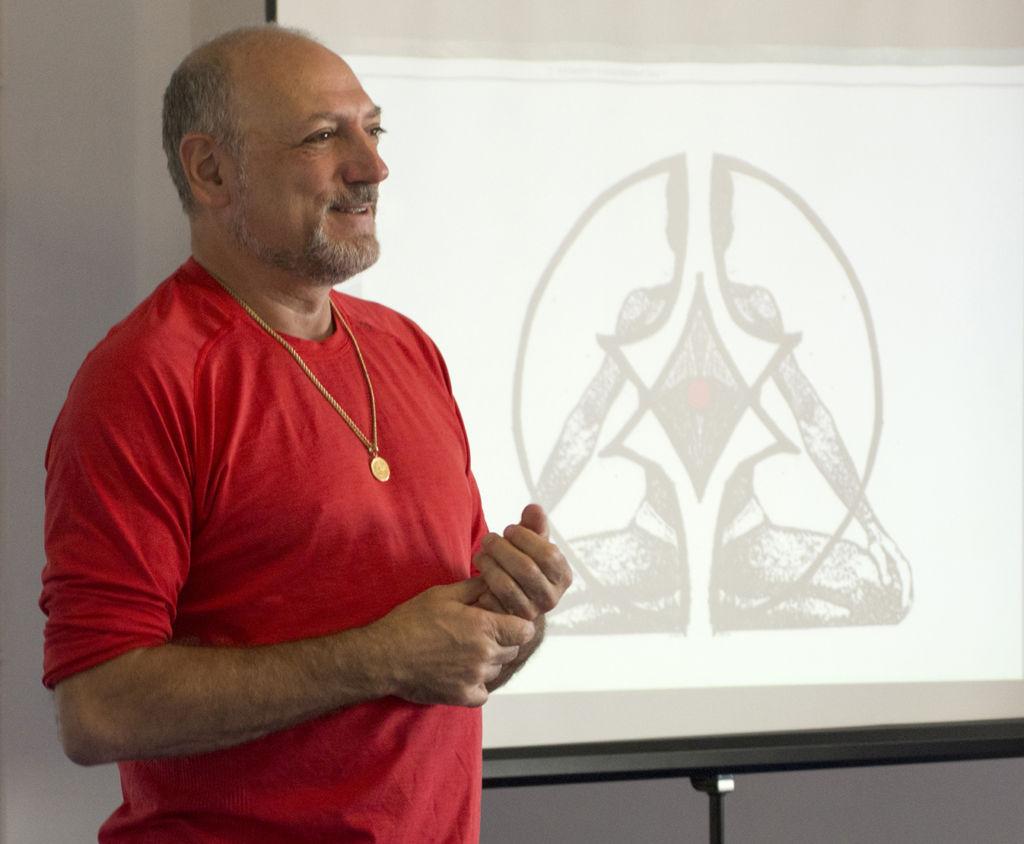
During the last 5 minutes, the class meditated on a figure of overlapping triangles with a center point.  Leslie asked us to sit with our “associations, insights, and connections between the visual image and the practice,” just as he had to 25 years ago in the presence of his teacher, the great TKV Desikachar.  He then shared with us his private journal and drawings from that lesson, showing how broke the symbol apart into two separate triangles and reconstructed it again.

Back in that room, Leslie found meaning in the separate parts of the symbol before making it whole again, as one would examine the two distinct parts of the breath, then flow with the full breath.  An apt parallel to both what his teacher incited in him, and what he has begun to stir in us.  With Desikachar’s lesson in mind, Leslie had created an Advanced Practice without advanced poses, for yoga teacher and yoga student alike.

I’m Not a Yoga Therapist Anymore

This piece appeared in the 2008 (Volume 18) issue of “The International Journal of Yoga Therapy.” It was written at the request of the editor of the Journal, and is based on many discussions I’ve had with my IAYT colleagues over the  years.
As I enter my 30th year as a Yoga teacher, and the 25th year of full-time employment doing Yoga-based work with individuals, I’ve just recently figured out something that I consider to be vitally important: I no longer wish to known as a “Yoga therapist.”

This bit of clarity is largely due to the opportunity I’ve had to bounce ideas off my colleagues at IAYT and attendees at SYTAR, so it seems fitting to share this perspective in the pages of this journal. The process of producing a written summary based on repeated discussions with teachers, students, and friends is very familiar to me. It’s what I did 10 years ago when I started the email newslist e-Sutra with the following post:

I have been personally engaged in countless discussions [about standards for Yoga teachers and therapists] for at least the past seven years. In those seven years, my fundamental views about certification standards have not changed, although my arguments supporting those views have become simpler and clearer with each new discussion…I will now present to you what I hope will be a clear and persuasive overview of my position…(click “Read more!” below to continue)


When I first wrote that, the topic was the establishment of national certification standards for Yoga teachers, which culminated in the birth of the Yoga Alliance. IAYT’s recent ongoing dialogue about the scope of practice and definition of Yoga Therapy is an extension of this debate. In my view, the fundamentals underlying both issues are identical, and can be summed up by the following question: “How can we define our professional activities in a way that preserves our freedom to conduct our relationships with our students in a manner that honors the core principles of Yoga?”

To fully explain my answer to this question, a little personal history will be necessary. Back in 1993, when the certification dialogue was just starting, I was serving as vice-president of a non-profit group called Unity in Yoga, and I was the principal author of the following official position statement:

We enthusiastically support the ongoing dialogue addressing higher personal, professional, and ethical standards for Yoga teachers and therapists.
We are in support of a process that results in the establishment of Yoga as a respected personal and academic pursuit, and any certification or accreditation that may result.
We are, however, opposed to the establishment of any entity that assumes the authority to license or regulate Yoga teachers as professional practitioners and to enforce its standards on the Yoga community.

Against my objections, Unity in Yoga’s executive board decided to release only the first two sentences─an action I saw as a critical error. Shortly thereafter, I resigned from Unity in Yoga. Four years later, I witnessed another group of Yoga teachers make a similar error in collective judgment just before I resigned from the ad hoc committee that turned into the Yoga Alliance when it acquired Unity in Yoga’s non-profit status.

The error is this: It is not enough to say that you are supporting and establishing high standards for Yoga teacher training and certification. That’s the easy, obvious part. You must also state clearly, consistently, and defensibly what you are not supporting, on ethical grounds. Yoga ethics are very clear on this point. The teaching concerning what we should avoid (yama) is presented before the teachings about what we should pursue (niyama). Furthermore, the very first injunction is ahimsâ, the avoidance of doing harm. In the context of professional standards, what exactly must we avoid harming? The process of teaching Yoga. What is the vehicle for this process? The student-teacher relationship.

Therefore, the professional “yama” I adhere to is “I avoid engaging in any action that will lead to third-party interference in the student-teacher relationship.” My “niyama” is “I support and protect through my actions the sanctity, integrity, and freedom of the student-teacher relationship.”

Those statements are the core of my ethical and practical values as a practitioner, and it would be impossible for me to overstate their importance in my life. They reflect fundamental principles that tell me which actions to avoid, and which to pursue. Without consciously identifying those principles and validating their truth through my life’s experience, I could easily become lost and confused. My actions could proceed from fear and ignorance, and I could end up doing harm to myself, my students, and my profession.

The value of my original 1993 statement on standards has been repeatedly confirmed for me, and I continue to vigorously stand by it, with one exception. In the first sentence, I used the phrase “Yoga teachers and therapists.” I now realize that this phrase is redundant, confusing, and potentially harmful.

As the title of this piece implies, I am stating for the record that I no longer wish to known as a Yoga therapist. I have come to the conclusion that my continued use of the term would misrepresent the nature of my work, both to the public and to myself, and would violate the professional ethics I’ve outlined above.

This does not in any way mean that I intend to stop doing my job. In fact, I will be able to work far more effectively, having identified my actual job title: “Yoga educator.” In retrospect, I realize that from the moment I taught my first group âsana class until the present day, I’ve always had the same job. I’ve just been doing it more effectively by learning how to better tailor the teachings to individual needs. I used to unquestioningly assume that my education in anatomy, biomechanics, bodywork, physical rehabilitation, and philosophy granted me the right to call myself a therapist. But, in fact, it just turned me into a highly-educated Yoga teacher.

By understanding that a “Yoga therapist” is nothing more than a very good Yoga teacher, I can eliminate the troublesome word “therapy” from my job description. I no longer need to define what I do beyond stating that I educate people about how their bodies and minds can be more fully integrated through the use of breath, posture, and movement. Even when I employ touch as part of that process, it is only for the purpose of educating, not fixing.

Why is the word “therapy” troublesome? Let’s start with the dictionary. Judge for yourself which definition is closest to what we do:

Therapy (from the Greek therapeutikos, to attend or treat): treatment intended to relieve or heal a disorder; relating to the treatment of disease or disorders by remedial agents or methods…
Educate (from the Latin educere, to draw out): to train by formal instruction or supervised practice; to give intellectual, moral, and social instruction to someone; to provide information…

I submit that even the most highly skilled and experienced Yoga “Therapist” does not “treat disease…by remedial agents or methods.” This is the province of a medical system, whether it’s allopathic, naturopathic, or Ayurvedic. Yoga is not a medical system. Yoga is a set of principles that show us we are interconnected, multidimensional beings composed of body, breath, and mind. These teachings suggest strategies for identifying and reducing obstructions that can occur in any of these dimensions. When obstructions (klesha) are reduced, it is the human system itself that reestablishes a healthy balance. We simply show people how to make more space (sukha) in their bodies so prâna can flow more freely. It’s the body’s own resources that do the healing. In other words, the teacher doesn’t heal the student, the teachings do. This is my definition of Yoga therapy – it’s Yoga applied to the individual.

As Yoga educators, we must constantly remind ourselves of and preserve this essential truth by minding our yama and niyama.

We must not attempt to integrate ourselves into mainstream healthcare delivery by posing as a new therapeutic profession. Not only will this take us further from the truth of who we are, it will create destructive turf battles with established fields like physical therapy, massage therapy, dance therapy, and so on.

We must not seek third-party reimbursement (de facto regulation) for our services, which are very affordable compared to medical treatment. If we are concerned about under-served populations, we are free to charitably offer our skills to them. This will be vastly easier to do without health insurance bureaucrats dictating our rates while wasting our time filling out their paperwork.

Most importantly, we must not seek out or surrender to government control (licensing) over our precious and unique field. This would be a betrayal of our students, who have sought us out precisely because we are outside the mainstream. After all, Yoga is ultimately about freedom. How can we represent that freedom if we allow ourselves to be co-opted by an oppressive system?

How then do we reach all the patients and doctors within mainstream healthcare who desperately need our skills? My answer is that we already are.

All across the world, we Yoga educators are sharing our vital work in every area of healthcare delivery by virtue of what we do best: connecting with people. This sharing will only grow exponentially as more doctors, nurses, administrators, and business people become our students, transform their lives, and advocate on our behalf. If we continue to take a strong stand for our own freedom as educators, we can have nothing but a positive influence on everyone. This is especially true for those working and being treated within mainstream healthcare, whose freedoms have been severely eroded by the destructive aspects of a system that’s forgotten to honor above all else the practitioner-patient relationship.

Is some form of government regulation of our field inevitable? Perhaps we can’t avoid it forever, but consider this: would you rather be answerable to the authorities as a healthcare provider, or as an educator?

Lastly, committing ourselves to the educational/academic model reveals perhaps the most important area we should be pursuing: the institution of undergraduate and graduate Yoga training programs at the university level. There is no reason on earth why serious students shouldn’t be able to acquire bachelor’s, master’s or doctorate-level training in any and all aspects of Yoga. A university-based Yoga program would unite in an unprecedented way many existing departments: anatomy, kinesiology, physiology, anthropology, philosophy, psychology, religion, Sanskrit, to name just a handful. The majority of the necessary resources are already there. All that’s missing is a staff of experienced Yoga teachers to design and administer the Yoga training.

Think of what a valuable resource a full-blown Department of Yoga would be to a university! Students, teachers, and administrators in every department would benefit from the availability of ongoing, high-level, campus-based Yoga training. If we really want to be more accepted by doctors, there is no better way than to teach them Yoga while they’re still in medical school.

I guarantee that the first university with the vision to create a degree program in Yoga would be deluged by applications from highly motivated, deeply-committed students. It’s a cherished dream of mine to see this happen in my lifetime─perhaps soon enough for my younger sons to take advantage of it.

This brief piece does not permit me to explore all the implications of my view, and I am well aware there are a great many (including what the “T” in IAYT might be changed to). I sincerely hope a lively dialogue will emerge as you consider the possibility of re-identifying yourself as what you truly are: a Yoga educator. I’d love to hear from you.

In closing, I salute the leadership of IAYT for their enlightened stewardship of our field, and for their open-mindedness in allowing my ideas to appear in their journal. The fact that you are reading this is ample evidence of their commitment to a truly open dialogue, and I am deeply honored that they have welcomed me into this forum.

Leslie Kaminoff is the founder of the Breathing Project, a nonprofit educational corporation in New York City dedicated to the teaching of individualized, breath-centered Yoga practice. He is also the co-author of the book “Yoga Anatomy.”