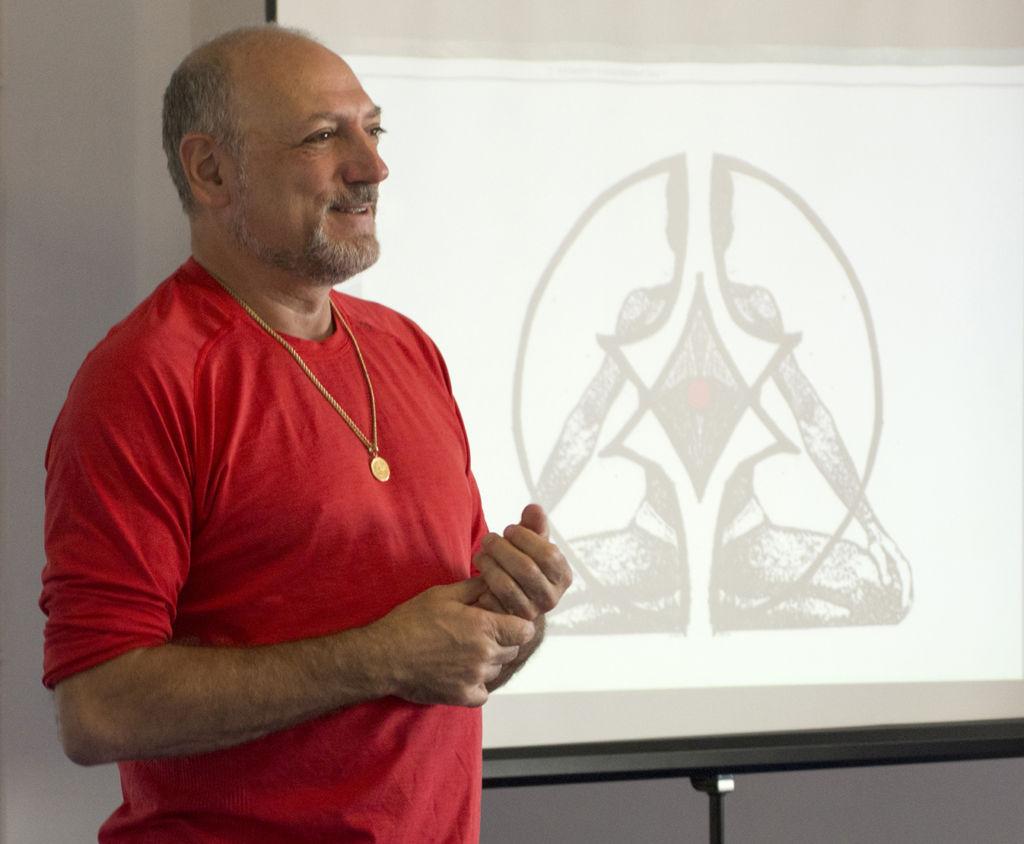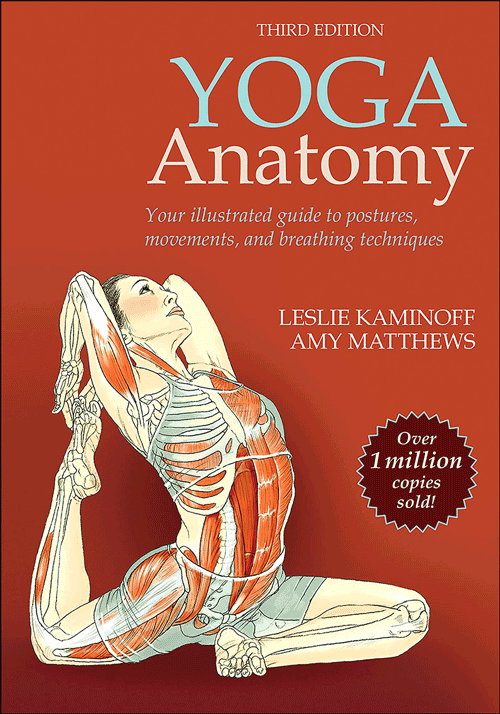

It’s always fun when Amy drops in on one of my advanced studies classes. This time, it was in response to the provocative question “is breathing an asana? It sparked a very interesting exchange. Enjoy!
Category Archives: yoga anatomy
A lively discussion on Amazon
I stayed up until 4AM on Feb. 7th to insure that mine was the first Amazon review of William J. Broad’s “The Science of Yoga.” My review is listed as “the most helpful critical review” and as of this writing 237 of 264 people found it helpful. It has also generated 47 comments by Amazon users. It makes for some interesting reading.
Should Yoga be covered by your Insurance?
Anyone who’s been following me for a while already knows the answer to this question, but you should watch the video anyway. This discussion is sure to be heating up again, now that yoga has been proven to be life-threatening, and its teachers so horribly under-regulated.
yogijbrown: Is Your Yoga Safe?

Another great piece from my friend J. Brown’s blog. He’s given me permission to re-publish on e-Sutra anything I think my readers will enjoy, and I’m sure this qualifies.
————————————-
From J. Brown:
Infrequent visitors to the yoga blogosphere may not be aware of the recent kerfuffle surrounding a NY Times article about how yoga will hurt you, but there also has been some mainstream media coverage on the safety of yoga.
While the article seems to have broken a few glass jaws in the broader yoga community, practitioners with a therapeutic orientation have been sounding alarms about questionable practice for years and getting nothing but flak in return. Those with the courage to take a stand and level public criticism of overly aggressive and guitar-hero-like approaches are usually written off as haters who are just jealous of the cool kids with their feet on their heads.
I’m not going to address the article directly. This has been done well enough already by voices more qualified than mine (I recommend watching Leslie Kaminoff’s three-part video response.) But I am interested in people questioning what they are doing and whether or not it is safe, even if it is a byproduct of a sensationalistic and irresponsible ploy to sell books.
Unfortunately, the subsequent conversation has largely been dominated by a reach for easy answers that avoid deeper issues. More often than not, injuries in yoga are being attributed to a lack of proper alignment or understanding of anatomy. It is said either that practitioners are not doing the poses in a technically correct way or that their teachers are not educated enough about anatomy to instruct students how to do the poses in a technically correct way.
When it comes to alignment, I find it curious to notice teachers who are are usually quite rigid in their instruction are now bending over backwards to explain how they respond to the needs of students. Specifically, I was reading an excerpt from a new book, written by a senior teacher in a classical tradition, who was considering the instruction to “straighten your leg.”
Without referring to any particular poses, the author asserts that the instruction is a “very coarse truth [that] new students need to hear” and that the way to accommodate different capabilities is to offer different “levels of truth” in the form of more detailed directives (i.e. lift the quadriceps, resist with the calf muscle, root the three corners of the feet, etc.) The suggestion is that different students need different details as they develop the fully realized truth behind “straighten your leg.”
The problem is that finding different ways of articulating the same arbitrary configuration is not an example of how to adapt to the needs of students and certainly will not make the practice any safer for the large majority of people who benefit from bending their knees. The concept of “technically correct” is open to interpretation and much of what is considered proper alignment in the classical forms is contraindicated for huge portions of the population. Thus, it is possible to have perfect alignment and still hurt yourself.
For those who are inclined to rely on science, I have written a full length article for Yoga Therapy Today magazine entitled: Does Studying Anatomy Make Yoga Safer? In the piece, I ask several prominent anatomy for yoga teachers to weigh in on the role of studying anatomy and science in making yoga safe. What I think most people might find surprising is that even the experts in the field do not agree that anatomy is the key to ensuring safety in yoga.
As Neil Pearson, clinical assistant professor at the University of British Columbia and the chair of the Pain Science Division of the Canadian Physiotherapy Association, put it: “In the end, it is not Western scientific knowledge of the human body that will make Yoga safer. Changing the students approach to the discipline of yoga and the practice of asana will create the greatest shift.”
Instead of looking to alignment and anatomy as a panacea for what ails the yoga profession, perhaps we would do better to foster a different mentality around the physical work of yoga practice that minimizes any potential risks and encourages smarter choices.
Most of the professionals I have spoken to agree that the key to safe yoga boils down to the sensitivity and adaptability of the instructor, his or her capacity for dialogue with and responsiveness to a student, and the humble confidence of knowing what you know and what you don’t know.
Video Review of “The Science of Yoga: The Risks and the Rewards,” by William J. Broad and a defense of my friend Larry Payne
In this video review, I accuse William J. Broad of launching an ad hominem attack on my friend Larry Payne. Realizing this may need further explanation, I offer the following:
“Ad Hominem” literally means “against the man.” It is the name of an often-employed logical fallacy that seeks to refute a person’s ideas by discrediting their character. For example, “Mr. Smith is known to be a drunkard, therefore his views on the economy should be dismissed.”
As I mentioned in the video, as a longtime friend of Larry Payne and teacher of the anatomy section of his LMU course each year in Los Angeles, I am hardly a neutral observer regarding Larry. This does not reduce my ability to offer objective criticism of Broad’s tactics in this part of his book.
On page 154 of “The Science of Yoga,” Broad lays the cornerstone of his attack: “If the origins of the modern field [yoga therapy] can be traced to a single person, it would be Larry Payne.” Here, Broad is preparing a case of guilt by association in which he will try to discredit the entire field of “modern yoga therapy” by assaulting the character of the person he is identifying as its key founder. He will go on to portray Larry as an opportunistic huckster who, unlike Loren Fishman, M.D., one of Broad’s heroes, took what he considers an easy path to credibility by obtaining a Ph.D. from a questionable school. Broad goes on to point out some commonly-held physiological errors that ended up in Larry’s book “Yoga for Dummies” as a way of further discrediting him.
Broad’s clear goal in the chapter in question (chapter five for those following along) is to cast aspersions on the organization Larry helped to found, the International Association of Yoga Therapists (IAYT), by drawing a parallel between what he perceives as Larry’s lack of a valid credential and the certificate one obtains upon joining IAYT. Broad observes that the IAYT membership certificate resembles a professional accreditation, but “a quick read shows that the document is in fact quite meaningless…The phony credential does an injustice to the talented yoga therapists who have labored for years and decades to develop their healing expertise and have helped countless people.”
This is a classic example of an ad hominem attack, setting up guilt by association. Forget the fact that Larry Payne is also one of the “talented yoga therapists who have labored for years and decades to develop their healing expertise and have helped countless people.” Forget the fact that IAYT has never represented their membership certificate as anything other than what it clearly states on its face. Forget the fact that never – to my knowledge – has any yoga therapist, whether a member of IAYT or not, expressed outrage over misrepresentation via a ”phony credential.” Forget the fact that there is a real, live human being named Larry Payne at the other end of this attack who has been walking around for the past week feeling like he’s been simultaneously kicked in the gut and stabbed in the back by the writer to whom he granted – in good faith – full access and lengthy interviews.
William J. Broad makes a strong case for accurately representing oneself in the professional sphere. Did he do that when he approached my friend Larry for the purpose of writing an authoritative book about the field in which he has faithfully labored for four decades? I’m sure Larry Payne, Ph.D. welcomed Mr. Broad with the same open heart he offers to everyone he encounters. He deserves far better than what he got in “The Science of Yoga.”
Egg On My Neck, part 2 of My 2 Cents about ‘How Yoga Can Wreck Your Body’
Last week’s video got quite a lot of attention on YouTube – over 12,500 views as of this writing. This week’s follow-up includes an apology to William J. Broad, the author of the NYT article and the book “The Science of Yoga”, which was sent to me by the publishers this week.
In last week’s video, I had taken Broad to task for under-reporting the “normal” range of motion of the cervical spine in axial rotation as 50º. In fact, that is the same number I give in the 2nd edition of Yoga Anatomy! Oops. Egg on my “neck”.
In retrospect, I believe I used outdated numbers in the book and I’m in the process of researching how to revise that page (34). Here’s one of the research articles I’m referencing that gives a good overview of just how variable these range of motion (ROM) measurements can be. For example, compare the lowest ROM—for a male in his nineties—at 26º. The greatest ROM was a teenage female with a whopping 94º! So, what’s normal?
I’m about halfway through Broad’s book now, and I’m pleased to report that it’s a great read. I will have a full review when I’m done but even at this point I can safely say I’m going to recommend every serious student of yoga read it.
The Case for the 3-D Diaphragm
There is no question that teaching people the efficient use of the
diaphragm is very important. Problems arise, however, when the action
of the diaphragm is viewed in the limited context of its effect on
movements in only the abdominal region of the body. This action, often
referred to as “belly breathing” represents only one dimension of the
increase in volume that the diaphragm creates in the thoracic cavity;
the vertical. I will explain how the diaphragm is capable of increasing
all three dimensions of the thoracic cavity, namely: the vertical
(top-to-bottom), the transverse (side-to-side) and the sagittal
(front-to-back).
What are the problems that arise from this limited perspective?
Many people who teach and learn abdominal breathing determine the
quality of their breathing only by its location in the torso, i.e.:
abdominal movement is good, thoracic movement is bad. This ignores the
critical issue of effort. It is possible (indeed, quite common) to do
tense belly breathing, just as it is possible to do relaxed chest
breathing. In addition, this top/bottom distinction is only
one-dimensional, as it ignores important lateral and sagittal breath
movements .
By equating abdominal shape change with diaphragmatic breathing and
thoracic shape change with accessory (non-diaphragmatic action), a
false distinction is perpetuated between diaphragmatic and
non-diaphragmatic breathing. ALL breathing is diaphragmatic (except in
cases of paralysis, such as quadriplegia). It is untrue and damaging
to suggest to someone who predominantly exhibits thoracic shape change
that they are not using their diaphragm. They are using it
inefficiently, and perhaps in combination with many other unnecessary
muscles, but they are certainly using the diaphragm.
By accepting abdominal breathing as “correct,” learning and
automatizing the habit, the breathing mechanism becomes less adaptable.
Being stuck in any pattern will create problems, regardless of how
useful that pattern may be in a given context.
Please keep in mind that it is not my intention to negate or disparage
the enormous benefits that derive from leaning the conscious use of the
diaphragm thru abdominal breathing. It is my intention to literally
bring a more three-dimensional approach to the field of breath
training .
Breathing as Shape-Change
To clarify this perspective on the breath, it will be useful to clearly
define what I mean by breathing. In the context of this argument, the
term breathing is being limited to the mechanical act of increasing and
decreasing thoracic volume; in other words, inhaling and exhaling.
A useful definition for breathing is: “The shape change of the thoracic
and abdominal cavities.” Both cavities – by definition – must change
shape in the act of breathing; the diaphragm is the floor of one and
the roof of the other. There is, however, a significant difference in
how the two cavities change shape in the act of breathing. The thoracic
cavity – like a bellows – changes its shape and volume, while the
abdominal cavity – like a water balloon – changes its shape, but not
its volume. This is why it is misleading to describe an abdominal
breath as an “expansion” of the belly; it is actually a bulging of the
abdomen, who’s contents are non-compressible or expandable. This is in
the context of breathing only; in the context of other life-processes,
the abdominal contents will of course fill and empty, thus changing
their volume. It should be noted though, that any increase in abdominal
volume will require a decrease in overall thoracic volume. This is why
it is temporarily harder to breathe “on a full stomach” and chronically
harder to breathe if you are obese or pregnant.
The muscles that control the shape change of breathing are usually
categorized as “muscles of inspiration” and “muscles of expiration.”
This can be confusing, since some “exhaling” muscles can be quite
active during an inhale, and vice versa. I prefer to categorize the
muscles by their effect on thoracic volume; there are muscles that act
to increase thoracic volume (principally the diaphragm), and there are
muscles that act to decrease thoracic volume (primarily the abdominals
and internal intercostals).
Accessory Muscle Action
Muscles other than the diaphragm that can increase thoracic volume are
commonly referred to as accesory muscles of inspiration, and these
include the external intercostals, the scalenes, the
strenocleidomastoids, the pectoralis minor, the serratus anterior, and
others that must work to stabilize them.
There are no accessory muscles of thoracic volume reduction due to the
fact that they are ALL accessory to the passive elastic recoil that
produces exhalation in a relaxed state.
Of the accessory muscles, the external intercostals are most important
to understand. Although the diaphragm is capable of expanding the
ribcage without their help (see below), they are frequently involved in
thoracic breath movements. It has been argued that ANY intercostal
muscle – because of its location between the ribs – is incapable of
expanding the ribcage by virtue of the fact that muscles can only
shorten; therefore it would be obvious that a shortening muscle lying
between the ribs could only draw those ribs closer to each other in an
exhalation.
The above argument would hold up if it were not for the fact that the
space between the ribs actually remains constant during all phases of
breathing, and the changes in volume of the ribcage are brought about
by the SLIDING of the ribs in relation to each other during
respiration. The intercostals, being arranged in perpendicular layers
oblique to the direction of this rib sliding are, in fact, ideally
suited to assist in respiratory movements.
How the Diaphragm Expands the Ribcage in 3-D
A closer look at how the thoracic cavity changes its shape reveals
several facts:
The best-known fact is that the contracting muscular fibers of the
diaphragm pull the central tendon downward, lowering the floor of the
cavity, thus increasing its vertical dimension. This is a description
of the famous “abdominal breath.”
A lesser-known fact is that the contracting fibers of the diaphragm
pull the base of the ribcage upwards, causing the ribs to hinge at
their costovertebral articulations, thus increasing the transverse and
sagittal dimensions of the thoracic cavity. This is why it is correct
to say that the diaphragm creates three-dimensional expansion of
thoracic volume.
Like many muscles, the diaphragm can move its insertion towards it
origin (central tendon towards base of ribcage), or its origin towards
its insertion (base of ribcage towards central tendon). It’s all a
question of which end of the muscle is mobile, and which is stable.
From this perspective, a belly breath is the result of stabilizing the
diaphragm’s origin and mobilizing its insertion, while a chest breath
is the result of stabilizing the diaphragm’s insertion and mobilizing
its origin.
The Unobstructed Breath
Of course, it’s possible to release all of the diaphragm’s stabilizing
muscles, and allow its origin and insertion to freely move towards each
other. This is the definition of an “unobstructed breath.” This rarely
occurs, as the need to stabilize the body’s mass in gravity will cause
many of the respiratory stabilizing muscles to remain active through
all phases of breathing. The goal of breath training (on a planet with
gravity anyway) is create the most efficient (least obstructed)
postural/breath patterns possible in an ongoing context of body
position/movement and effort/intention.
Since the diaphragm, in an unobstructed state, will create 3-D shape
change in the thorax, intentionally isolating that shape change in the
abdominal region requires one to block the other dimensions of
movement. In other words, abdominal breathing requires the contraction
of the muscles that restrict rib movement. Furthermore, it also
requires the relaxation of the abdominal wall. By persistently
breathing in this pattern, one will develop a chronic tightness in the
thoracic structures that support the shoulder girdle and head, as well
as a chronic weakness in the abdominal wall, which provides support for
the lower spine. In short, habitual abdominal breathing interferes
with effective postural support. It is precisely this action of
disengaging postural support that can make abdominal breathing useful
for supine relaxation (if it’s done in a non-tense manner).
Significant problems will arise if that pattern persists upon standing
up, for the breath will be prevented from adapting to the demands of
vertical support.
The Emotional Connection
It should be noted that the pattern described above also limits
emotional flexibility, as it habitually reduces the sensory perception
of space and movement within one’s chest and abdomen – the metaphorical
“heart and gut centers” we all seem to need more connection with. In
short, although belly breathing may reudce some stress symptoms in its
practitioners, getting stuck in that pattern presents the very real
possibility of reinforcing one’s emotional defense mechanisms.
Think of what you do in your belly to protect yourself from a punch;
now picture doing that more or less all the time on a subtle,
subconscious level. Now picture moving that tension forward and back
as you breathe, and you’ll understand how many people do their
abdominal breathing without ever really releasing the underlying
tension.
Yoga
In a fundamental way, this relationship of breathing patterns to the
critical issues of support and release forms the methodological basis
of yoga practice. Breath and posture are different ways of viewing the
same thing.
Breath is how we move space through ourselves, and posture is how we
move ourselves through space. Or, breathing is about changing the
shape of our body cavities, and posture is about maintaining the shape
of our body cavities.
This perspective is clearly expressed by Patanjali in the second
chapter of the Yogasutra when he defines asana practice as
Sthirasukhamasanam: Sthira (stability) and Sukha (ease) are the dual
qualities of Asana (yoga posture).
Another take on Sthira and Sukha relates those terms to the exploration
- on all levels – of the healthy relationship between boundaries and
space. This includes our sensory, emotional, intellectual and spiritual
spaces – but it all starts with getting the physical spaces to
cooperate in a harmonious way.
Breath Flow in Yoga Practice
Breath Flow
11/2/01
SUBJECT – BREATHING FLOW
FROM – MUKUNDA STILES
Query – A basic question for the group. Some Indian yoga teachers teach how to breathe in three part motion like filling a glass from the bottom upward. In this image one is to inhale expanding the belly first then let the air raise upward into the chest. Some others teach breathing in reverse following the pattern of the diaphragm. I would like to take a survey and find out which method goes with each of the styles of Hatha yoga. I would appreciate hearing from students representing each method.
I would also like to hear your personal and teacher’s comments as to what you experience as the benefits or detriments of each.
——————
Leslie responds:
This post addresses an area in which I specialize, so I can’t resist a response.
The easy part of the answer relates to which schools teach the different approaches to breathing.
The only lineage I’m aware of that explicitly teaches the “top to bottom” breath is Krishnamacharya’s. Specifically, Viniyoga, the method taught by his son Desikachar, is the system in which this is found. The ashtanga yoga of Sri K. Pattabhi Jois (another student of Krishnamacharya’s) teaches the control of the lower abdomen through mula bandha, so the “top to bottom” breath is somewhat implicit in that approach, although many of K.P.J.’s students have different opinions about breathing methodology ( a few of them are on the list, so perhaps they’d like to chime in). Prof. K.’s other famous student, Mr. Iyengar, seems to favor the bottom-to-top pattern (at least that’s what I recall from reading his book “Light on Pranayama”).
It should be pointed out that in Viniyoga, there is no “right” way to breathe; all instruction is given on an individual basis, and “bottom to top” breathing (or any number of other patterns) may be prescribed if it is useful for certain students in certain situations.
All the other schools of yoga that I’m aware of teach some variation of the “bucket breath” (bottom to top) approach that Mukunda describes; which brings me to the second part of my response.
Embedded in Mukunda’s description of these breathing patterns are a few oft-repeated inaccuracies that perpetuate much confusion about breathing (I don’t mean to imply that the well-learned Mukunda is confused — he’s just asking the questions).
Let’s look at: “Some Indian yoga teachers teach how to breathe in three part motion like filling a glass from the bottom upward. In this image one is to inhale expanding the belly first then let the air raise upward into the chest.”
**Air never rises upward into the chest** Here’s why:
A glass or a bucket filling from the bottom upward is a very common image and justification that’s given for this 3-part breathing pattern. The problem with it is that the lungs are not a bucket, and air is not water. Actually, what’s more fundamentally erroneous is the entire notion that the order in which you change the shape of your body cavities during inhalation has something to do with the order in which the different parts of the lungs will fill with air. This is simply not the case, and it comes from the almost universal confusion between muscular movements and air movements.
During breathing, air only goes in and out from the lungs, and it can only move through the lungs by means of the bronchial tree. The inhaled air enters from the top downward, branches left and right, then fans out from center to periphery. The path of the exhaled air, of course, follows the exact opposite pattern. This pathway remains the same no matter how you manipulate your respiratory muscles.
**A belly breath does NOT bring air into the belly NOR does it cause the lower part of the lungs to fill first.** Sorry, folks; I know how often this stuff gets repeated, and how attached to our teaching language we can become.
Mukunda’s next statement was: “Some others teach breathing in reverse following the pattern of the diaphragm.”
I don’t really know what Mukunda means by “following the pattern of the diaphragm,” so perhaps he could clarify it for us. I do know that the statement would be more correct if he substituted the phrase “bronchial tree” for diaphragm.
There’s a lot more I could say about this (enough to fill the book I’m working on!), but I’d prefer to continue this dialogue by answering questions about my response, and posting other responses to Mukunda’s question.
===============================
SUBJECT – BREATHING FLOW
FROM – MUKUNDA STILES
I thank Leslie for his comments. Indeed even such a simple instruction as this has been the source of much confusion and deliberation. I am reminded of the great Lilliput controversy in Gulliver’s Travels as to whether to open the egg from the pointed side or the rounded side. Grounds for war! Or at least an inflamed pitta. Today such controversy pales in contrast with the greater concerns for peace and recovery of our connection with the universal Life Breath’s rhythm that was lost in the recent tragedy (9/11/01).
In the last post I said: “Some others teach breathing in reverse following the pattern of the diaphragm.” The diaphragm moves downward as one inhales thus setting in motion a wave from the lower thoracic region into the abdominal and pelvic cavities. While breath of course first enters the bronchial tree as Leslie points out, the principle respiratory muscle is the diaphragm temporarily able to be under our control. Some instructors, mostly those trained by Krishnamacharya, Desikachar, and Indra Devi – myself included — use this image to convey how to breathe. My curiosity is to what variations are there in the different schools of yoga.
stay well and happy,
Jai Ma
Mukunda Tom Stiles
((LK: Not to nitpick too much here, but “…the diaphragm moves downward as one inhales…” is unclear. First of all, the phrasing makes it seem like the movement of the diaphragm is something distinct from the act of inhaling. Also, the fundamental activity of the diaphragm is not downward movement; it is contraction. It is possible to contract the diaphragm in such a way that it creates upward movement of the ribcage rather than downward movement of the central tendon (this is what occurs when you keep your abdominals engaged during an inhalation). For more on this, see my notes following the next post.
So, I would rephrase Mukunda’s statement as: “The inhale is created by the contaction of the diaphragm.” Even that is a partial statement, as it doesn’t include prior factors in the causal chain of inhalation.))
=================
Subject: Breathing Flow
From: Valdeane W. Brown, Ph.D.
Part of the confusion in these various approaches to instruction come from
conflating the anatomical, with the physiological with the phenomenological.
Anatomically, we can divide the respiratory system into three component:
viz., the diaphragmatic, thoracic and apical each correlating with a
specific “region” of the physical body. In most people, most of the time,
diaphragmatic breathing is sacrified and even precluded, by a forward
rotation of the lowest ribs.
((LK: See note #1 below…))
This rotation drops those ribs downwards and this partially encloses the diaphragm — and this prevents it from expanding (fully).
((LK: See note #2 below…))
Because of this constriction, the majority of the respiratory
activity (what Leslie refers to as “muscular”…) is carried by the thoracic
region (the “rib cage” area), or even the apical region (the clavicular
region). The most direct result of this is a huge increase in respiratory
rate, with baselines of 16-22 bpm (breaths per min) being reported in
western literature as being normative!
((LK: See note #3 below…))
In beginning to shift this pattern and, among other things, slowing down the
respiratory rate, a number of observable and demonstrable changes begin to
occur. The first is that the lower ribs must be rotated back up to their
“natural” positiion. This is one of the direct outcomes of correct asana,
esp with the standing poses, in terms of effect on respiration. Unless this
rotation occurs, and the spine is naturally upright (with its intrinsic
gentle curves) it will simply be impossible for the resipatory rate to
decrease. This shift is frequently experienced by the student as “breathing
dropping down into the abdomen” or something like that — this is the
phenomenological part I spoke of above.
In any event, regardless of how it “feels” to the student, regardless of how
the muscular engages, regardless of how the skeletal structure aligns to
support “full breathing” — or doesn’t! — Leslie is correct that the actual
respiration follows the bronchiolae and that occurs in a downward fashion.
This is the physiological perspective I mentioned above.
Light on Pranayama by Iyengar describes much of the phenomenological level,
and is, IMO, quite thorough and clear. Most other traditions, in my
experience, emphasize one or the other perspectives and one or other of the
specific pranayama practices at the expense of the others. This is, in my
experience, generally due to a lack of complete understanding of all of the
various practices and their applications.
I hope this helps clarify this somewhat.
val
———–
Leslie’s notes:
#1 – <
Here, the term “diaphragmatic breathing” is being used synonymously with “abdominal breathing” (Val confusingly labels the abdominal component of breath movement as “diaphragmatic”). What I think he is really saying is that most people’s bellies don’t move enough when they inhale.
Surely, Prof. Brown can’t mean that in most people, most of the time, the diaphragm is not functioning! An accurate example of a person who’s diaphragmatic breathing is “precluded” would be Christopher Reeve. IMO, it is inaccurate and harmful to suggest to people that their diaphragm is non-functional; it may be functioning *inefficiently* because of habitual tension in its antagonistic muscles, but all of us certainly have functioning diaphragms (except in cases of paralysis).
#2 – <<...and this partially encloses the diaphragm-- and this prevents it from expanding (fully).
Again, Val says diaphragm when he means abdomen. The diaphragm doesn't expand. Like all muscles, it only contracts and relaxes. The question is how effectively/efficiently a muscle is able to do that. Actually, to be technically correct, it's not even accurate to say that the abdomen expands; the abdominal cavity is non-compressible like a water balloon; it changes its shape, but not its volume. If you squeeze on one end, it will bulge somewhere else. What appears to be expansion is a forward displacement of the organs caused by the descending diaphragm; so rather than expanding during an inhale, the abdomen bulges forward. The ribcage does expand during an inhale, though; its ability to change its volume is what creates the pressure changes of breathing. So, the abdominal cavity changes its shape, but not its volume; while the thoracic cavity changes its shape AND its volume.
#3 - <
Here again, equating diaphragmatic with abdominal breathing creates confusion; this time promoting the common misconception that thoracic breathing is non-diaphragmatic. In fact, the diaphragm is constructed in such a way that it causes expansion in all three of the areas that Val mentions (abdominal, thoracic and clavicular).
When discussing the ways in which our chest and abdominal cavities change shape during respiration, it is less confusing to refer to the components of the breath by the spatial dimensions in which they move.
The vertical (top to bottom) dimension corresponds to the downward movement of the central tendon (insertion) of the diaphragm, which results in the forward bulging of the upper abdomen (belly breathing).
Along with the downward pressure, an upward lift is created by the diaphragm’s contraction as it acts upon its attachment (origin) at the circumference of the lower ribcage. This creates movement in the lateral (side-to-side) dimension in the lower ribs, as well as a sagittal (front-to-back) movement in the sternum.
In short, the diaphragm can create 3-dimensional expansion of the thoracic cavity; so, to equate diaphragmatic breathing only with its abdominal component is to leave out at least two thirds of the picture.
========================
From: Collyn Rivers
Leslie,
I appreciate your rational explanation of up/down breathing because many
of the various theories seem at variance with basic anatomy.
The thorax surely is basically a cylinder open to the atmosphere at the
top (via the bronchial tree) and closed at the bottom by the diaphragm. The
diaghragm is periodically caused to contract downwards, creating more
space, and thus a partial vacuum at the base of the lungs. This in turn
causes air to flow into the lungs from top to bottom via the bronchial tree.
As you say air cannot possibly flow from bottom to top (unless one somehow
breathes through the anus via passages yet unknown!).
In the process the diaphragm presses down on the abdomen causing it to
move outward. Relaxing the abdominal muscles will therefore enable the
diaphragm to move more easily and/or fully – enabling more air to be drawn
in.
Contracting the abdominal muscles will push the diaphragm upwards and thus
presumably enhance exhalation.
Or is there something that I’m missing?
Collyn Rivers
((LK: No, sounds pretty good to me. The only thing I would change is this: rather than saying “the diaghragm..contract(s) downwards, creating more space, and thus a partial vacuum at the base of the lungs,” I’d say “…the diaphragm’s contraction increases the volume of the thoracic cavity, thus lowering it’s pressure relative to the atmosphere” (volume and pressure are inversely related). The partial vacuum is not located specifically in the base of the lungs; there is never actually a vacuum anywhere, as the pressure is constantly maintained as long as the respiratory passageways remain open. One can experience a partial vacuum during uddiyana bandha performed on the retention after an exhale, as the ribcage increases its volume, but no air enters to equalize the pressure. That is why the abdominal organs are pulled upward towards that vacuum.))
========================
From: Fran
To quote Leslie:
“**A belly breath does NOT bring air into the belly NOR does it
cause the lower part of the lungs to fill first.**
It has always been my understanding that, as is quoted above, the “belly
breath” does not actually bring breath into the belly (an anatomical
impossibility, I should think); but that through the expansion of the
belly and rib cage area, it DOES provide additional space for the
expansion of the diaphragm, which in turn provides additional space for
the lungs to expand.
Fran
((LK: I hope my notes above clarify my points. Please remember my quote was referring primarily to the *sequence* of expansion during an inhale, which was what Mukunda’s original question was addressing.))
============================
From: Larry Payne
Mukundaji,
Leslie Kaminoff is a real expert on this but this is my personal feeling on the matter.
The chest to belly is primarily from Viniyoga. When I first came to Desikachar’s house in early 1980 there was an article in the French Yoga magazine that said he was the “Yogi who breathed backwards.” When I took my first teacher training from Sivananda they taught belly to chest.
Both methods certainly have merit and have helped a lot of people.
Desikachar quotes numerous ancient texts that talk about the prana going down to the apana.
From a mechanical standpoint if you watch closely the spine gets more continuous work when you start from the chest going down. The chest fills, then the belly – there are no gaps or breaks in the working of the spine. When you start from the belly up there is a slight pause as the diaphragm is going down it looks like an S. It is subtle but noticeable.
Also in Viniyoga, chest to belly works nicely in coordination with the raising of the arms. Finally, if you talk to a Yogi who has had a partial lung removed or something of that nature (like Marsha Accomazzo who was one of the founding board members of the International Association of Yoga Therapists) they will tell you that they feel more volume of air if they start from the top.
This is just quick off the top of my head as I am in the final stages of my book but I hope it is a helpful start.
Shanti,
Larry
======================
From: Matt Lerner
My first training back in the 70s was in the style of the Himalayan
Institute. We learned to teach “from the bottom up”, but I believe this was
only suggested as a teaching aid, so that a student could visualize filling
completely. I don’t think it was ever suggested that the air actually moved
that way. We called this particular breath the “complete Yogic breath” and
we only taught it to beginners. We started with a deep exhalation, then we
began : 1) expanding the belly; 2) expanding the ribs; 3) lifting the
shoulders/clavicles to completely fill. We would often count “1-2-3″ for
each of the three segments, then reverse it for the exhalation.
I look forward to Mukunda’s response, but I believe he is referring to the
movement of the “dome” of the diaphragm. As you inhale, it contracts, and
the dome moves down as the diaphragm flattens.
Namaste,
Matt
matt [at] aum [dot] org Spiritual Life Society and Hudson Yoga Center www.aum.org
((LK: What is usually referred to as the “dome” is the central tendon, which is non-contractile tissue. The muscular fibres of the diaphragm are primarily oriented in the vertical, not the horizontal plane; as they shorten, they pull downward on the central tendon and upward on the base of the ribcage.))
=======================
FROM: gilli harouvi, Ashtanga Yoga- the israeli center, Tel-Aviv.
Lovely thread! and an utterly important one. YES, let us deal with the
stigmas.
first- a few feed backs :
leslie responded to Mukunda:
> It should be pointed out that in Viniyoga, there is no “right” way to
> breathe; all instruction is given on an individual basis, and “bottom to
top”
> breathing (or any number of other patterns) may be prescribed if it is
useful
> for certain students in certain situations.
I am of the Ashtanga Vinyasa school, Sri K.P.Jois’s tradition. But anyway,
me, too, do not recognize anyWRONG WAY to breath. the problem is that most
of us forget to breath – mostly because we are afraid to get hit on the butt
by an “authority”, with or without brackets. So, if you breath- you are on
the right track. then- choose it. Whenever I hear the term “correct breath”
I freack out. there is no wrong way to breath, guys. please, be specific!
also in Leslie’s response:
> A glass or a bucket filling from the bottom upward is a very common image
and
> justification that’s given for this 3-part breathing pattern. The problem
> with it is that the lungs are not a bucket, and air is not water>
Of course. elementary, Mr. Watson. air is no water, amazing, ha?
brrrrr…..!
(actually, it is adifferent element. but do not tell anyone else. this info
is still a sectet)
And for my humble input:
As I mentioned, I am trained in the Ashtanga vinyasa way, beloved Sri
K.P.Jois’s tradition.
During practice of the Ashtanga sequences,there are 2 key elements (to start
with) that the oractitioner has to observe, learn, undrrstand AND practice:
one is the famous Moulla-bandha-Uddiyana-bandha concept, and the other is
the Ujjayi breath, through the nose, via the partially closed Larinks
(beginning of the air pipe, base of the throat) and into the lungs, filling
them fully and in specific rythme. breathing slowly and strongly, same
tythme in and out, creating the famous “stable fullo of co-ordinated
astmatic horses” sound (all rights for the expressin reserved, be warned!).
the breath and the bandhas support each other, quite cleverly I think:
1. proper mulla-uddiyana-bandha control lifts the pelvic floor and
controlls the lower abdomen, creating a relatively tight bathing-suite all
around the middle section of the body, protecting the lower back AND the
abdomen from possible over-strain during the intense asana practice, which
the Ashtanga is famous for
2. if the abdomen is held in and controlled due to the bandhas, breath can
not go into the abdomen Nor the abdomen should expand: for most people, if
breath goes into the abdomen- Bandhas will release automatically. and then
one is more likely to injure onself IF PRACTICING INTENSLY. and ashtanga,
as I recognize it and love it passionatly, is intense. but practiced
properly with those protective measures one os fully protected. guaranteed.
and on:
so the breath goes up to the lungs, opening up the chest and its entire
anatomy (Yogic and western) , LIFTING prana and doing clever tricks with the
prana-apana relationship. on the physical level we extend up and away,
creating more space between the vertabraes and enhancing our ability to
practice asanas correctly, strongly, and behold- the ultmate stira-sukham
evolves. (as I said before, my oppinion)
Mukunda, hope this is helpful.
blessings from the troubled Holy Land, and please pray with us to stop
violence. Or at least to create a little “violence-vritti-nirodha.”
NAMASTE,GILLI
((LK: Thanks, Gilli. BTW, I think your English is great for a guy who’s not used to writing vowels into his words. : ) ))
===========================
From: Carl Horowitz
I have also encountered one school of practice where the breath is taught
in this order.
1. Expansion of the rib-cage.
2. Expansion of the chest.
3. Expansion of the abdomen
on inhale. And:
1. Contraction of the abdomen from the bottom up.
on exhale.
I don’t know what I think about saying that this is the right way to
breathe.
But it also depends on the pose you are doing what part of your body
expands first.
When you are swinging your arms out, around and up, like in many popular
versions of a sun salutation, the above order of expansion may naturally
happen with the movement, because the arms reaching out to the side causes the
rib-cage to expand out to the sides, and the arms raising then causes the chest
to expand. But if you focused on beginning the same movement with external
rotation of the arms before you started swinging them out around and up you
would end up breathing into your chest first.
If you were doing a side lean you may expand the rib-cage on one side
more than the other as you inhale. You also may focus on the expansion of
the rib-cage on that side before you expanded the chest. This should
just happen as a result of the shape your body has taken in the pose.
Twists change the shape of the body asymmetrically as well and if you are
doing a twist and one leg is restricting movement of part of you
abdomen, then you would not be able to breath as deeply into the part
of the abdomen where movement is restricted. You may also breathe more
into one side of the rib-cage, and you would probably use the intercostal
muscles and the muscles of the abdomen that are creating the twist to help press
air out on the exhale a little more than you would normally.
Some forward bends may demand that there is very little movement in the
abdomen because the abdomen’s expansion is restricted by the legs.
Child’s pose would be an example. Try breathing into your abdomen in
child’s pose and notice how much tension this can create.
Some back bends enhance the expansion of the chest on inhale, and some back
bends are so deep that they can restrict movement in the chest while you are
holding the pose; so you may not be able to expand the chest any more than it
already is while inhaling in a pose like urdhva dhanurasana.
So the way the body expands and contracts during the breathing process not
only changes as a result of the individual and his/her needs, but also as a
result of the shape the body has taken in the position it is in.
Peace.
=================
From: Owen Daly
Dear ESutra,
I do not have Leslie’s broad and deep exposure to different teachers and traditions, and I have not made the effort Mukunda is making to differentiate between the different styles of Hatha Yoga. I honor both of your approaches as good and useful. I do offer my take on the subject in hopes that it will add to the discussion.
Filling the lungs from the bottom up or from the top down are images, not biological reality as Leslie correctly points out. That does not invalidate them, but to the contrary, helps point out that images are one of the most evocative tools a yoga teacher has. As Angela Farmer has said in her workshops and on her beautiful tape ‘The Feminine Unfolding’, “The body loves images.”
We call the asana ‘Mountain’, not ‘standing up straight’ and ‘Down Dog’, not ‘on hands and feet with your butt up in the air’. My thought is that we do this because of the images they evoke and the body’s response to those images.
Long before medical science looked inside the body to see the mechanics and then the chemistry of how the body functions yogiis had very useful images of the flows of energy throughout the body, of which breath was a key part.
Paying attention to the breath helps you concentrate. Giving yourself or a student an image facilitates this process. Different images result in different physical results. These physical results are reasonably consistent for different individuals. To me, one of the delights of Yoga is the discovery of the physical result in my body from working with the images that have been discovered, refined and handed down over long periods of time.
I find that ‘bottom up breath’ has somewhat different physical results from ‘top down breath’, but both result in a slow conscious filling of the lungs to near capacity. The sensation I get is that bottom up draws more attention to the belly and is more grounding and top down draws attention to the head and is more uplifting.
I do not mean to communicate that images are the objective, but they are a useful tool, remembering that there is both embracing an image and the ability to let go of the image and be with what is, but that is another discussion.
-Owen Daly
((LK: I would say that images, like metaphors and emotions are real. They are real as *experiences*. For me, the relevant question is: “Do the images, metaphors and emotions that I experience correspond to objective reality or not?” All the images I use when teaching yoga correspond to anatomical reality.))
===================
From: jj gormley
Hi Leslie:
I’m certainly no expert on all this, but thought I’d at least share
how I teach breathing–which does not follow any particular school,
but what I’ve picked up on over the years. My personal background is
about 50:50 iyengar and non-iyengar.
To my beginning students I teach softening the belly muscles to allow
the breath to move the diaphragm downward, hence moving the organs
outward. this i call belly breathing.
Next, I teach what I call complete breath which sounds like what
Mukunda is talking about. I teach students to keep the belly muscles
soft at first to allow movement of the belly by the initial part of
the breath. But then the rest of the breath–most of the breath will
begin to expand the ribs outward and upward.
next (the third breath i teach to my beginners) is keeping a little
bit of abdominal muscles working, while at the same time releasing
the ribs so that the breath expands the ribs outward/upward/backward.
This is the beginning practice of moving toward Ujjayi which I refine
a bit more in the more intermediate level classes. I might remark
that I teach the breath down the back of the nasal passageway to
create the “sound of ujjayi” is from a relaxation rather than a
tension or constricted feeling that is usually taught in Iyengar
methods.
I also of course, teach numerous other breaths in the upper level
classes I teach.
Also, I teach that the way the breath or “air” enters into the lungs
is always the same, but how you relax and/or tense parts of the body
can create different breaths and that there are hundreds of breaths
in yoga. And, that NO breath is right and NO breath is wrong. What
is important is to assess what kind of breathinng we’ve been doing
all our life and then, as all yoga practice is to bring balance by
making changes in our habitual way of moving, thinking, and here in
breathing, we change our breath habits in a short breath practice
each day (roughly). Over time, our ability to do many different
types of yogic breaths will improve. As this happens, our nervous
system becomes stronger and able to handle stress better.
That’s it in a nutshell.
in love and light,
jj gormley
sun and moon yoga studio
2105 N Pollard St
Arlington, VA 22207
703 525 9642
1-888-786-9642
============
Isn’t it the movement of the diaphragm that brings the air into the lungs?
This may be part of the confusion. On inhale the diaphragm causes the air to enter the lungs, the diaphragm goes down (contracts)which causes (or can cause) the abdomen to go out (thus the idea is created that air goes there, which it doesn’t). On exhale the diaphragm rises, stale air is released and then new air is sucked back into the lungs. At least this is what I understand.
Sharon
((LK: yup.))
==================
From: Shirley Worth
I haven’t contributed much, though I thoroughly enjoy the
“conversations” on this list and very much appreciate Leslie’s
efforts in keeping it going.
But Tom Stiles’ question about breath touched a chord from my early
yoga days, when I took classes from a teacher who taught the “3-part
yoga breath” and taught us to breathe first into the belly, then
middle chest, then upper chest — a practice I felt was effective in
deepening my breath. After practicing that for a while, I took
pranayama classes from Iyengar teachers who introduced me to more
complex patterns and empasized observing the sensations associated
with the breath — a practice I felt succeeded in softening my breath.
After several years, I had an opportunity to observe another class
taught by my early teacher — and was a little shocked at the
harshness of the breath in students who were putting such forceful
effort into following her careful instructions on how to breathe.
Since then it has been my fascination to find out how to both soften
and deepen the breath in my own practice, and how to help students in
my classes do the same. What I think I have figured out is that it’s
not enough just to describe a practice to the student who will then
do her best to do what I describe, working into all his weaknesses
and conditioned movement habits to do so. I need to observe how the
student interprets and expresses what I describe, and then adjust my
description for that individual student at that particular time.
Leslie, I liked your comment about “confusion between muscular
movements and air movements” and explanation of both. I have a
question: You said, “A belly breath does NOT bring air into the
belly…” I wonder is that the same as saying a b.b. does not bring
prana into the belly? I’m thinking (could be wrong of course) that
expanding the belly really does nothing for deepening the breath,
because lung expansion comes from the ribs doing that pump handle
thing and the diaphragm going flat. (Does poofing the belly out
really help the diaphragm contract??) But I remember sometimes after
a vigorous session of belly breathing, I would feel like belching.
Any comments??
Shirley
((LK: Many people learn to exaggerate the “bulging belly inhale” because they were taught that this is the proper way to use the diaphragm. A belly breath is actually created by simultaneously contracting the diaphragm along with the muscles that limit ribcage movement. Overdoing this pattern has the effect of tightening the ribcage and upper back and over-stretching the muscles of the upper abdomen. Other effects can include belching and acid reflux.))
=========================
Subject: Breathing Flow:
From: Valdeane W. Brown, Ph.D.
Actually Leslie I was being very precise and did mean to reference
diaphragmatic breathing as an emphasis of the entire respiratory process and
to keep that distinct from any emphasis on the movement of the abdomen per
se. My experience is that the focus on the movement of the abdomen is not
that useful and is not very clear. There are many, many reasons that the
abdomen may move during respiration — and many of those reasons may have
little to nothing to do with facilitating respiration re se and certainly
not with facilitating pranayama.
The use of the term “Diapragmatic breathing” vs “Thoracic” or “Apical”
breathing is fairly standard in psychophysiological circles and indicates
the relative prominence of each of these anatomically localized “regions”
rather than any absolute reference to just the relevant musculature. In
actual fact it is extremely difficult to register no muscular activity in
any of those regions whenevery any respiratory activity occurs; however, it
can and does happen. The relevant psychophysiological measure is the
relative degree of muscular activity within each region (referenced to its
own prior history as measured by EMG sensors) and the degree of muscular
activity within each of the regions in contrast to the amounts measured in
the other regions. These measurements, coupled with measurements of total
volume of air, end tidal volume, shape of the response curve of the muscular
activity, and the blood gas dynamics, have been used to really understand
the psychophysiology of respiration in various contexts.
((LK: I’m still confused by your terminology. If “diaphragmmatic” refers to a region of movement, what is that region? The structure of the diaphragm extends from “nipple to navel” (between the 4th and 6th rib spaces and the 2nd and 3rd lumbar vertebrae). Also, how does one get a direct EMG reading of diaphragmmatic activity? Where do you stick the electrodes?))
When I reference the downward rotation of the lowest ribs as enclosing the
diaphragm and precluding its “expanding” fully, it seems to me that that
message is fairly clear. When they are rotated downwards, the lower ribs
become, in effect, a cage enclosing the diaphragm in that and this “cage”
precludes the radially outward movement range of the diaphragm. This effect
can be demonstrated quite easily with EMG sensors.
((LK: The diaphragm is a muscular structure, and as such, it does not expand; it contracts. So, your terminology is still confusing me. The only structures that truly expand (increase in volume) during respiration are the lungs and ribcage. It’s anatomically correct to say that the contraction of the diaphragm causes the expansion of the ribcage, yet you seem to be saying that a contraction of the ribcage prevents the expansion of the diaphragm!))
One of the major reasons to emphasize this aspect of the respiratory process
is that, while much attention is frequently focussed on decreasing
respiratory rate, not many instructors focus on the precise postural
disturbance of the downward rotation of the lowest ribs which is what
directly increases respiratory rate for physiological reasons. Without
correcting this precise imbalance, the diaphragm will remain constricted in
its “centrifugal expansion”, and this will place a limit of range of
decrease possible in respiratory rate. Focussing on the movement of the
abdoment will not alter this structural limit, the lower ribs must be
rotated back upwards first or else a fairly absolute “floor” is set re:
lowering respiratory rate.
((LK: The above would make sense to me if you simply said: “….. the *ribcage* will remain constricted in its “centrifugal expansion”…….” ))
The faster respiratory rate directly affects the amount of CO2 saturated in
the blood and this directly affects the degree of anxiety experienced by the
student. Yes, in end stage COPD (chronic obstructive pulmonary disease) the
movement of the diaphragm can become almost totally eclipsed. Again, this
has been demonstrated with EMG sensors and other psychophysiological
monitoring systems. It is one of the specific reasons that the “air hunger”
encountered by person suffering from COPD is experienced as anxiety instead
of suffocation even though it is, in fact, also suffocating. Administering
anti-anxiety agents helps alleviate both symptoms in those cases, and is
another factor in understanding that it is respiratory rate that is critical
as the direct pharmacologic affect of anti-anxiety agents is to decrease
respiratory rate.
BTW, I am a psychologist but not a professor; however, my wife was a
professor of psychology/psychiatry. I am also a 35+ year yoga, meditation
and chinese martial art practitioner and very long time teacher of all
three. I also ran a pain management program for a number of years that was
based on an intensive yoga and pranayama component, somewhat along the lines
of what has been done by Kabat-Zinn and Ornish.
I hope that this forum continues to be an arena in which sharing about yoga,
pranayama and practice can continue and I thank you for your efforts to
establish and facilitate it.
Jai Bhagwan,
val
======================
From: tatiana
YOGALOCA [at] aol [dot] com from Los Angeles would like to throw her hat into the pranayama debate.
In most instances, I teach mulabandha breathing, as taught by my teacher Dona Holleman. Exceptions are when student is creating tension by using this method. BKS Iyengar in Light on Pranayama also explains this same breath, but calls it complete pranayamic breath.
As one inhales through the nostrils, the breath descends through a wide, lower throat down into the abdomen. The abdominal muscles gently contract to the sacrum, while the perineum lifts gently. The breath then should be visualized as moving up the inner spine to the top of the head, using the jalandrabandha to complete the inhalation. On the exhalation, the breath releases from the nostrils downward again toward the abdomen.
Of course, the breath only moves into the bronchial tree.
((LK: You mean the *air* only moves into the bronchial tree. It is important to use the words “breath” and “air” appropriately in order to avoid confusion. “Breath” can mean any type of movement (air, pressure, muscles, blood gasses, imagery, etc.) that accompanies respiration. In her article in Yoga Journal about a year and a half ago, I specifically remember Dona Holleman saying that in “Mulabandha” breathing, the *AIR* descends into the abdomen during the inhale. Look it up…it’s right there in black and white. I was stunned that nobody corrected it prior to publication. So, you said breath when you meant air, and Dona said air when she meant breath.))
However, the movement of the abdomen toward the sacrum on the inhalation creates a wave action, which as the sit bones descend and the perineum (mulabandha) lifts, then, moves up the spine. As the abdominal organs have been moved up and back (gentle uddiyanabandha), the diaphragm cannot descend on the inhale, and thus has to move sideways, expanding the lower ribs. The wave which began in the lower body then moves up the inner spine, elongating the spine, moving into the latissimus, pectorals and brings the entire ribcage up. Finally the wave is caught by the jalandrabandha and extended to the crown of the head, much like a wave of the ocean, cresting, then crashing down, as the breath is exhaled. This breath can be used in pranayama, but more importantly, can also be used in asana to create more energy in the body.
In Dona Holleman’s book, DANCING THE BODY OF LIGHT, there is a fuller and more eloquent description.
I also use the analogy of a glass filling with water to describe the filling of the torso with breath, with energy. The idea being that prana and apana must be kept moving. That prana must be moved into the sushumna, up towards the brain. More oxygen, more quiet mind, soothed nervous system. Expanding the abdomen on the inhalation is more a relaxing breath.
tatiana
((LK: The abdominal breath can be relaxing if it’s done in a relaxed manner. It’s possible to do tense abdominal breathing, just as it’s possible to do relaxed clavicular breathing. The location of breath movement is just one among many factors that determine the quality of breathing.
Also, watch your “p’s” and “P’s” when writing about Prana. When you speak of the prana/apana relationship, it’s a lowercase “p.” When you speak of Prana as the sum total of our life-energy, it’s the Uppercase “P.” In Viniyoga breathing methodology, it’s the “Big P.” that you want in your shushumna — which is where it will naturally go once you’ve removed the obstruction called kundalini.))
=======================
SUBJECT – BREATHING
FROM – Mukunda Stiles
I just returned from 2 weeks away teaching in Boston and was delighted to see such a wonderful dialog on breathing. I am still getting some personal questions about this process of how we breath. I am especially appreciative of all of you who engaged so fully in inquiry about the benefits to physiology, energy and questions that were raised about how the respiratory muscles are involved when we go into controlled yogic breathing. Clearly we all have a lot to learn and share from each other. I am grateful at reading Leslie’s insightful comments on the motions of the diaphragm. This is the kind of dialog I used to enjoy in Institute for Yoga Teacher Education (now Iyengar Yoga Institute) during my trainings with yoga physiology teacher (now psychiatrist Paul Copeland) and Judith Lasater.
I am surprised that I did not notice several groups represented in the discussions and I would love to hear from Anusara Yoga, Bikram Yoga, and Swarupa Yoga teachers about whether you are taught to breathe from top down or bottom up and your findings of its benefits and detriments. I don’t know of other groups that might not have input into the dialog but I would love to hear from all methods.
stay well and happy,
Jai Ma
Mukunda Tom Stiles
1660 Egret Way
Superior, CO. 80027
720-304-3922
==================
From: Leslie Kaminoff
I just found the passage I previously referred to in Iyengar’s “Light on Pranayama.”
On page 23 of the hardcover edition, Chapter 4, Sec. 18 refers to a “total or pranayamic inspiration” as progressing from the action of lowering the dome of the diaphragm to “the next action of the sequence, the elevation and expansion of the lower ribcage in ascending upwards.” Basically, bottom-to-top.
This appears to be different from what Judith Lasater has said she was taught personally by Mr. Iyengar, i.e.: expanding the inhale three-dimensionally.
==================
From: Carl Horowitz
<<((LK...All the images I use when teaching yoga correspond to anatomical
reality.))>>
What if an image that does not correspond to anatomical reality causes a
particular student to understand what they are doing with their body and/or
their breath more effectively than an image that corresponds to anatomical
reality? Wouldn’t this be a way of matching the practice to the needs
of the student? Of course it might be a good idea for the teacher to
understand what is going on anatomically first, before coming up with visual
images that do not correspond to what is really going on anatomically.
Peace.
———————-
Leslie responds:
I agree. I didn’t mean to imply that I had a problem with non-anatomical images used in yoga teaching; as long as the teacher knows what they are doing. I have a personal preference for anatomy-based images because I teach anatomically based classes and workshops that focus on the structure of the breathing mechanism.
Even so, there is a distinction between on the one hand, anatomy-based and reality-based imagery, and on the other hand, faulty anatomy-based and fantasy-based imagery. The former brings you closer to clarity, while the latter brings you further from clarity.
Not all reality-based imagery is anatomically grounded, but it does correspond to the sensory, emotional and practical realities of what’s going on with a particular student; I believe that’s what you’re referring to above.
An example of faulty anatomy based-imagery would be: asking a student to inhale the *air* into the base of the lungs first, then make it rise upwards to the top of the lungs. As we’ve discussed, this doesn’t happen because of the structure of the bronchial tree, and reinforcing that image takes one further from clarity.
An example of fantasy-based imagery would be: asking a student to breathe in white light, surround themselves in it, breathe it back out into the world, so it can expand all the way to the Middle East, where it will enter into the hearts of all the terrorists who want to kill us, and suddenly make them realise that they should stop hating us because they are contributing to the wounding of our collective soul. Reinforcing an image like that takes one really far from clarity.
In short, my view is that the use of imagery in the teaching of yoga should for the purpose of bringing the student closer to a state of clarity about the interrelatedness of their mind, body and breath.
==========================
From: Tatiana Yogaloca [at] aol [dot] com
I am greatly enjoying the breath dialogue. Thank you for creating this forum where we can understand better our own training by juxtapositioning it with other training.
In your response to me re: ‘mulabandha breathing’ as taught by Dona Holleman, you pointed out quite correctly that breath, air and prana (little p, or big P, makes a difference), are to be treated carefully. Recalling that Dona was trained originally by Mr. Iyengar over 40 years ago, and that as you pointed out in Light on Pranayama, Mr. Iyengar calls it a full pranayamic breath, I believe this ‘mulabandha breath’ and pranayamic breath are the same.
((LK: I don’t get that at all, but it’s hard to tell from written accounts. It’s difficult enough to be clear when teaching this stuff one-on-one to a student. One absolutely should not try to learn pranayama from a book or an article.))
I am pleased to read Mukunda’s call to teachers from the various schools to explain their training in the breathing flow, and look forward to more dialogue.
…..wanted to add that the Iyengar system does teach a three part breath called Viloma, inhaling from the pubic bone to the navel, pausing, continuing the inhale from the navel to the nipple area, pausing, then completing the inhalation from the nipple to the clavicle, pausing, then one long gentle exhale. (This also has variations Viloma I, II, and III).
This, of course, includes visualization, as you correctly pointed out before, the inhalation only goes into the bronchial tree. So what is being felt is a movement of energy.
Thanks again.
tatiana
===============
Hi from NYC
Re: Sivananda yoga = 3-part breath, starting from the abdomen, then ribcage (and all around the back for more advanced) and all the way up to under the clavicles (all around to the shoulder blades for more advanced) = Bottom to top
The exhale is also bottom-to-top.
FYI – Sivananda also relaxes “bottom to top” ((LK: I think you mean the progressive relaxation in Savasana at the end of class…))
Om shanti,
Vani Devi
=========================